
Finding Oceanside Residents
There is no single current roll of every Oceanside household. Start by naming the relationship you need to establish. A parcel search identifies land and assessed value. A recorded deed identifies parties to a transfer. A voter lookup authenticates a voter’s own registration, not a public street list. A court index identifies a case role and filing, while a vital record confirms an event under California’s authorized and informational copy rules. Printed directories, yearbooks, newspapers, and photographs add a time-bound household clue.
Use the narrowest record first, then test the result against an independent source. For a current address, pair GIS and an authorized title or deed channel. For a family connection, pair a vital or probate record with an obituary or directory entry. For an old house, preserve the legal description and historic street name before searching a modern number.
- Write down the name, address, approximate date, and the exact question. Keep owner, occupant, voter, party, and relative as separate roles.
- Find the parcel in the City of Oceanside GIS viewer and record its APN, shape, legal context, and nearby features.
- Use the San Diego County secured assessment roll for values and exemptions, knowing that web owner names are suppressed.
- Search the ARCC Official Records Index by party and date, then use a kiosk or copy route when the instrument itself matters.
- Finish with the library, court, vital, census, newspaper, or CPRA channel that fits the remaining gap.
Oceanside Resident Records Offices
Oceanside is an incorporated North County city, not a separate records county. San Diego County is the main custodian for land, recorder, county-clerk, elections, court, and many vital-record functions. The City Clerk handles municipal minutes, ordinances, contracts, correspondence, and California Public Records Act requests. The library and Historical Society hold the local shelf that official portals do not replace.
San Diego County ARCC
Recorder, Assessor, County Clerk
Public counter and kiosk channels
(619) 237-0502
San Diego County Assessor
Secured assessment roll
APN values and exemptions
(619) 236-3771
Assessment Roll Search
Registrar of Voters
5600 Overland Avenue
San Diego, CA 92123
(858) 565-5800
The registrar lists weekday office hours of 8:00 a.m. to 5:00 p.m. and accepts qualifying voter-data applications by mail or in person, not by email or fax. Recorder staff can explain copy and kiosk procedures. A custodian can confirm the right request path, but cannot be asked to create a new resident list.
Choose an Oceanside Record
Each source describes a different kind of association. Treat the result as evidence with a role and date, not as a universal resident label.
| Source | Useful association | Keeper | Access route |
|---|---|---|---|
| GIS and assessment roll | Parcel, value, exemption, location | Oceanside and San Diego County | Free web tools by address or APN |
| Official records index | Deed parties, liens, easements, maps | County Recorder | Free metadata; copy or kiosk for images |
| Voter lookup | One voter’s registration status and districts | Registrar of Voters | Self-authenticated lookup |
| Court index | Party role, case type, filing date | San Diego Superior Court | Online index, counter, mail, or case-specific document route |
| Directory, census, or newspaper | Listed household at a dated moment | Library, archives, NARA, repositories | Staff help, catalog, microfilm, or partner access |
A property record does not prove occupancy. A voter result does not open a voter’s full file. A court party is not necessarily a resident. A directory entry is a snapshot. These distinctions keep an Oceanside residents directory search useful without flattening every name into the same claim.
Oceanside GIS to Parcel
The Oceanside GIS viewer is the practical address start. Quick Search and Find Address accept an address, and the finder accepts an intersection written with two street names separated by an ampersand. Identify a parcel, note the APN, then inspect layers, districts, adjacent shapes, and the current extent. The tool offers point, line, shape, current-view, and all-selection modes, plus table, CSV, mailing-label, zoom, and clear controls where enabled.
That sequence converts a street clue into a parcel clue. It does not expose a citywide roster. Exported selections are clipped to the current map extent, so a small, deliberate view makes a better neighbor or block record than a broad map.
| GIS field or control | What it does |
|---|---|
| Quick Search / Find Address | Finds an address or an intersection such as Street A & Street B |
| Search Fields / Identify | Chooses layer fields or reads the clicked feature |
| Selectable Layer | Sets the parcel or feature layer available for selection |
| Geometry | Point, Line, Shape, Current View, or All |
| Buffer and nearby features | Adds a distance in feet and selects nearby features within that distance |
| Selection operation | New Selection, Add to, or Remove from |
| Output | Details, Table, CSV, Mailing labels, Zoom to All, or Clear |
Note: Save the APN and legal description before a parcel split or merge makes a later address search look unrelated.
Oceanside Assessor Values, No Web Owners
The secured assessment roll accepts a full APN in a hyphenated form such as 123-456-78-90, with a minimum eight-digit form of 123-456-78. The result can show land, improvement, and total assessed values, exemptions, Proposition 13 base or factored values, and the reason for a value change. It is not a tax bill, and the web result does not supply the owner name or owner mailing address.
California Government Code §6254.21 is the reason the common “enter an address and see the owner” expectation fails online. For a title question, use a recorded deed or an authorized county office channel. When a mailing address is lawfully available, keep it separate from the situs address. The first locates the land; the second routes correspondence. Neither alone proves who occupies a dwelling.
Useful distinction. Assessment facts can anchor a parcel, but ownership and occupancy require separate evidence from the recorder or another lawful custodian.
Recorder Metadata Since 1970
The ARCC recording guidance places the public index at 1970 to the present. Search by party name, document type, recording-date range, document number, or book and page. Grantor means the party transferring an interest; grantee means the party receiving it. The index can show roles, document type, date, number, book/page when supplied, and a legal or parcel reference, but not the public deed image.
APN searching was removed from the online Official Records Search on December 9, 2024. Five office kiosks retain APN searching. This is a useful local quirk: begin with GIS and assessment facts, obtain a party name through a lawful counter or copy route, then search the web index by name and narrow dates. At the 1970 edge, carry book/page and legal-description clues to staff or the County Archives.
| Official-record search field | Use in an Oceanside residents directory search |
|---|---|
| Name / Party | Try surname variants, initials, trusts, entities, and both grantor and grantee roles |
| Document Type | Narrow deeds, deeds of trust, reconveyances, liens, releases, easements, notices, or maps |
| Recording Date From / To | Reduce common-name results within the 1970-present index |
| Document Number | Retrieve a known instrument directly |
| Book / Page | Bridge references carried into later documents or older office research |
| APN | Unavailable online after December 9, 2024; use an office kiosk |
Current Oceanside Resident Directories
Current directory work is a set of partial views. The most reliable workflow states what each view can and cannot establish.
| Directory-like source | Lists or describes | Limit | Next check |
|---|---|---|---|
| GIS and secured roll | Parcels, APNs, value, exemptions | Owner name suppressed online | ARCC title or deed channel |
| Recorder index | Parties to recorded instruments | Party is not an occupant | Instrument image or legal description |
| Voter self-lookup | Authenticated voter status and districts | Not an open street roll | Voter or qualifying application |
| Permits and projects | Applicant, contractor, work dates | Does not prove occupancy | Production portal or CPRA request |
| Public civic contacts | Officials, organizations, events | Not a member roster | Published contact or archive inquiry |
The Oceanside eTRAKiT interface exposes permit, project, contractor, property, inspection, and license search labels, but the inspected page says “Pre-Production” and warns against real payments. Use permit records to date a building change and identify an applicant or contractor, not to declare who lived there. When the question is a whole street, use the Oceanside Street Directory address chain.
Voter Records Are Not a Street Roll
The San Diego County Voter Information Lookup asks a voter for first name, last name, date of birth, residence address, and ZIP Code. It is a self-authentication tool. A mismatch can reflect a different registered form, birth date, address, or ZIP. Government Code §7924.000 protects home street address, phone, email, precinct and prior-registration data, identifiers, and signature except where Elections Code §2194 permits a qualifying governmental, electoral, scholarly, journalistic, or political use.
The full voter-data application requires a requester identity, contact address, scope, detailed authorized purpose, security and confidentiality plan, delivery details, certification under penalty, and an original signature. It goes to the Registrar of Voters, 5600 Overland Avenue, San Diego, CA 92123, or the published mailing route. Safe at Home participants may register confidentially. A voter status is not proof of a current physical presence.
A county election office image is useful for understanding the custodian route, but it is not a substitute for the voter’s authenticated result. Use the registrar’s official contact information for a status or data-use question, not an informal request for another person’s protected fields.
The Registrar of Voters contact page identifies the official office route for Oceanside voter questions.
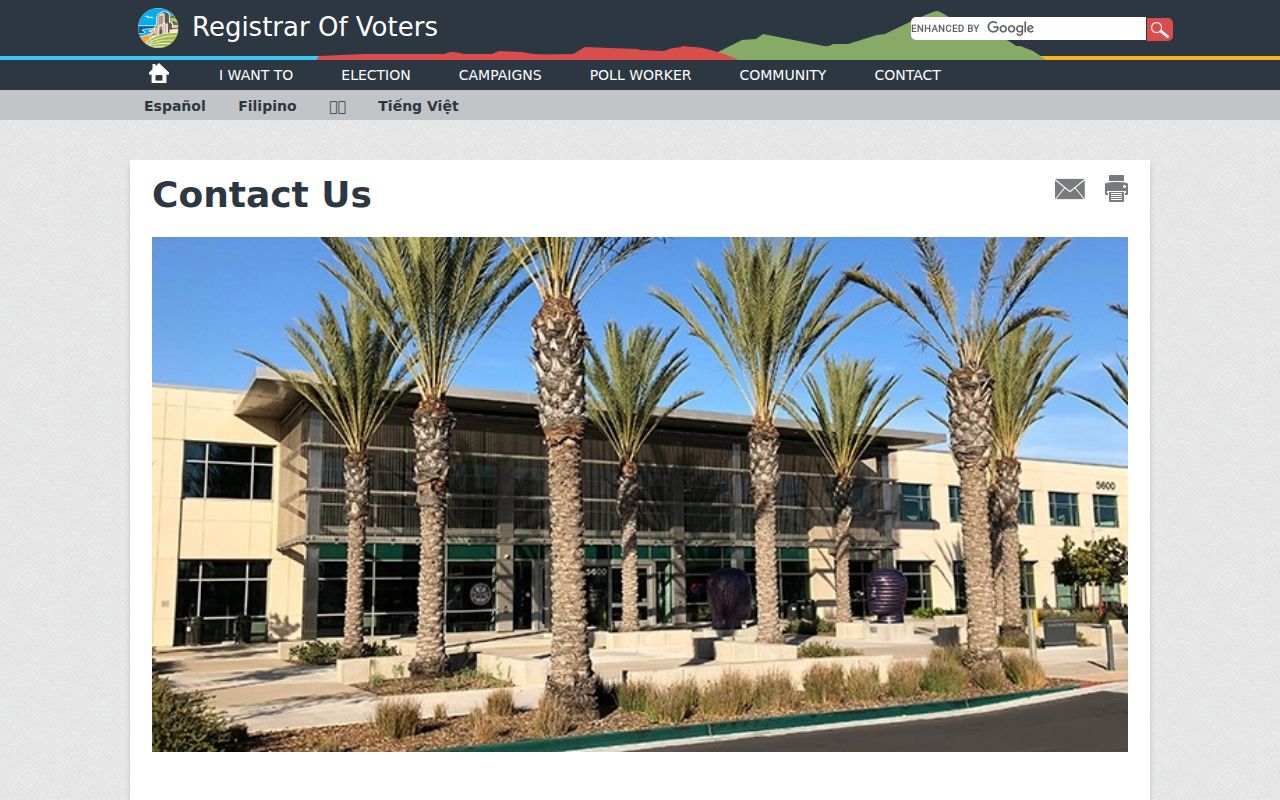
Contact details identify the custodian route; they do not open protected voter fields or create a public street roll.
Oceanside Court and Vital Trails
Oceanside cases route through the San Diego Superior Court, commonly the North County Division by venue and case type. The online index supports Party Name, Case Number, and DA Number modes for civil, criminal, family, mental-health, and probate categories. It excludes juvenile matters, traffic and minor offenses, and pre-1974 cases. The basic result shows a case title, number, facility, type, filing date, and parties. It does not by itself show a charge outcome or current address.
For a birth, death, marriage, or dissolution question, California uses an authorized-versus-informational copy model under Health and Safety Code §103526, not a blanket age-opening rule. San Diego County and CDPH divide custody by event and location. CDPH holdings begin in July 1905. Adoption files remain confidential under Family Code §9200, and divorce decrees come from the Superior Court. In 2026, the county announced copy fees of $34 for birth, $26 for death, and $19 for marriage, while CDPH lists $31, $26, $19, and $18 for birth, death, marriage, and dissolution. Confirm a current fee with the custodian before ordering. For a separate state name search, the California Megan's Law website is an official registry, not proof of current residence.
When no online index answers the question, court counter and mail channels, county vital applications, library indexes, newspaper files, and a focused CPRA request form the fallback chain. CPRA, Government Code §§7920.000-7931.000, opens identifiable existing records unless an exemption applies, but it does not require an agency to create a new resident list.
For the federal portion of a court search, use the official PACER system and check the Southern District of California docket. The image below points to that federal access layer.
County court and vital sources should be paired with the local context that made the name plausible. Never treat a case party, certificate, or index hit as proof of every fact about a person.
Oceanside Heritage Room Numbers
The Helen M. Nelson Heritage Room at the Civic Center Library holds more than 2,500 local-history books, files, clippings, and photographs focused on Oceanside, Southern California, and Camp Pendleton. Staff permission is obtained at the second-floor Customer Service Desk. Ask for vertical files by surname, street, subdivision, institution, and business, not only for a city-directory title. A clipping or caption can resolve a name that a formal index misses.
The Oceanside Historical Society’s Robert A. and Bessie J. Weese Oceanside History Center supplements the library with photographs, maps, organizational records, Water Utilities material, and Blade-Tribune leads. Its center is at 510 Civic Center Drive, Oceanside, CA 92054, with a P.O. Box 125, Oceanside, CA 92049-0125, phone (760) 722-4786, and the published Info@OceansideHistoricalSociety.org contact.
For a household story, record the image identifier, caption source, creator, estimated date, and related file series. A photograph can date a building or business and resolve an old street name, but it is not proof of every person pictured.
Old and New Oceanside Streets
Street names are part of the evidence. Historical sources identify First Street as Seagaze, Second as Mission Avenue, Third as Pier View Way, Fourth as Civic Center Drive, Hill as Coast Highway, and Couts as Wisconsin. The first pier ended at Couts, while a later pier reached Third. Search both forms, then use a parcel outline, plat, and legal description to bridge the change.
Oceanside incorporated on July 3, 1888, after railroad-era settlement around Andrew Jackson Myers’s 1883 homestead claim and San Luis Rey. Downtown and coastal blocks appear earliest in plats, newspapers, photographs, and directory-like sources. Fire Mountain, South Oceanside, Rancho del Oro, Ivey Ranch, Ocean Hills, and other later areas need modern subdivision maps, permits, and GIS layers. A no-hit under a modern street label may be a naming gap, not a missing household.
When Oceanside Searches End
A failed web search has a defined next step. Use a counter or kiosk for recorder data left out of the web interface. Use court public terminals, mail, and archive indexes for older or restricted case material. Use the county vital application route for a certificate and the library or historical society for a shelf lookup. Use a city CPRA request for an existing, identifiable municipal record, with date range, department, address, permit or project number, and record type.
The City Clerk’s CPRA process is not a duty to answer a research question or create a new list. The request should seek an existing record and ask for electronic copies when possible. Keep a negative-finding log with the spelling, portal, search mode, date span, and search date. Oceanside’s 1970 recorder cutoff, 1974 court web horizon, restricted voter file, suppressed assessor owner name, and renamed streets can each explain a no-hit.
Official links remain the safest route: the Oceanside City Clerk public-records request page describes the municipal channel, while ARCC and the court explain their own copy and archive limits.
Protecting Confidential Oceanside Addresses
Some missing data is a legal safeguard. Safe at Home, Government Code §§6205-6216, gives qualifying protected people a substitute mailing address and confidential voter treatment. Court juvenile, adoption, sealed, and confidential material can also stop a name trail. Assessor ownership is hidden from the public internet, voter data is use-restricted, and vital informational copies carry identity-use limits.
California privacy rights under the CCPA and CPRA include access, correction, deletion subject to exceptions, and choices about sale or sharing. The California Privacy Protection Agency’s data-broker registry and DROP provide the proper route for broker deletion requests. Correct a fact with its original custodian first. Do not use indirect clues to defeat a protective program or to infer a private location.
Lawful personal use. Oceanside records support family history, civic research, and personal safety. Do not use a name, address, image, or record trail to stalk, harass, intimidate, or harm anyone.
Historical Oceanside Directories
The historical side of an Oceanside residents directory begins at the Helen M. Nelson Heritage Room and the Weese History Center, not at an invented publisher list. Staff-held runs have dates that vary by collection. A typical entry may contain a surname, given name or initial, spouse or widow notation, occupation, employer, home or business address, and an abbreviation key. A reverse or criss-cross volume may order names by street and number. Ask staff for the exact shelf inventory before stating a year or publisher. The Oceanside Directory Book keeps that shelf method distinct from current records.
Pair a directory entry with the federal census, which is publicly available through 1950 as of 2026 under the 72-year release rule, then test the household against deeds, permits, newspapers, obituaries, or probate. Oceanside’s library began in 1904 and moved through several sites before the 1989 Civic Center, so a captioned address can itself become a useful lead.
The National Archives census research page explains the federal release layer used beside local directory evidence.
- Roll
- A list maintained for a defined purpose, such as assessment or election administration.
- Index
- A finding aid that points to a record; it is not always the record image.
- Parcel
- A mapped unit of land identified by an APN and legal description.
- Criss-cross directory
- A reverse directory arranged by street and number rather than only by surname.