
Oceanside Previous Residents: Era Sources
A house history assigns each source a question. San Diego County deeds establish transfers, not occupancy. Directories and census records add household clues; probate, permits, photographs, and obituaries explain changes and family links. These dates include gaps that should stay explicit.
| Source | Years It Covers | Where Held | What It Shows |
|---|---|---|---|
| Recorder official-records index | 1970-present | San Diego County ARCC web index; office kiosks | Parties, record dates, document types and numbers; images by copy or kiosk |
| Earlier deed indexes and books | Before 1970; opening year unconfirmed | ARCC office, five kiosks, county archives | Grantor/grantee entries, book/page references, legal descriptions |
| City and criss-cross directories | Exact local runs not published | Heritage Room and Weese History Center | Listed occupants by name or address for a dated snapshot |
| Federal census | Through 1950 | NARA and partner library databases | Households as counted on an enumeration date |
| Superior Court index | Broadly 1974-present; older 1880-mid-1974 central indexes | San Diego Superior Court and courthouse archives | Probate parties, heirs, case dates and related filings |
| Oceanside permits | Exact digitized start not confirmed | Development Services, eTRAKiT and records requests | Work scope, applicants, contractors and inspection dates |
| Sanborn fire-insurance maps | Exact Oceanside sheets and years not confirmed | Library of Congress and local library repositories | Building footprint, material, use and street context |
Use GIS and the current parcel for today's house, the Heritage Room or a photograph for an older block, and the recorder for a legal transfer. Pair a directory with a census for a household. A no-hit is not proof that no one lived there.
Oceanside Previous Resident Records and Kiosks
The San Diego County Assessor/Recorder/County Clerk, or ARCC, provides the central deed trail for Oceanside. Its Official Records Index reaches 1970-present and returns party names and roles, document type, recording date, document number, and book/page information when supplied. The index is not the deed image. Request a mailed copy or use an office kiosk for vesting language, legal descriptions, signatures, and notary details.
On December 9, 2024, APN searching was removed from the web index but remains at five ARCC kiosks. When an address first yields a parcel number, use Oceanside GIS to identify it, then use an authorized office channel or known deed party. The assessor's secured-roll page accepts an APN and shows assessment facts, but owner names are not posted online under Government Code §6254.21.
For earlier deeds, take the last book/page reference, legal description, subdivision, lot, and block to ARCC staff, a kiosk, or County Archives. Recording questions: (619) 238-8158; general Recorder/Clerk: (619) 237-0502. The ARCC Recorder-Clerk division lists office services.
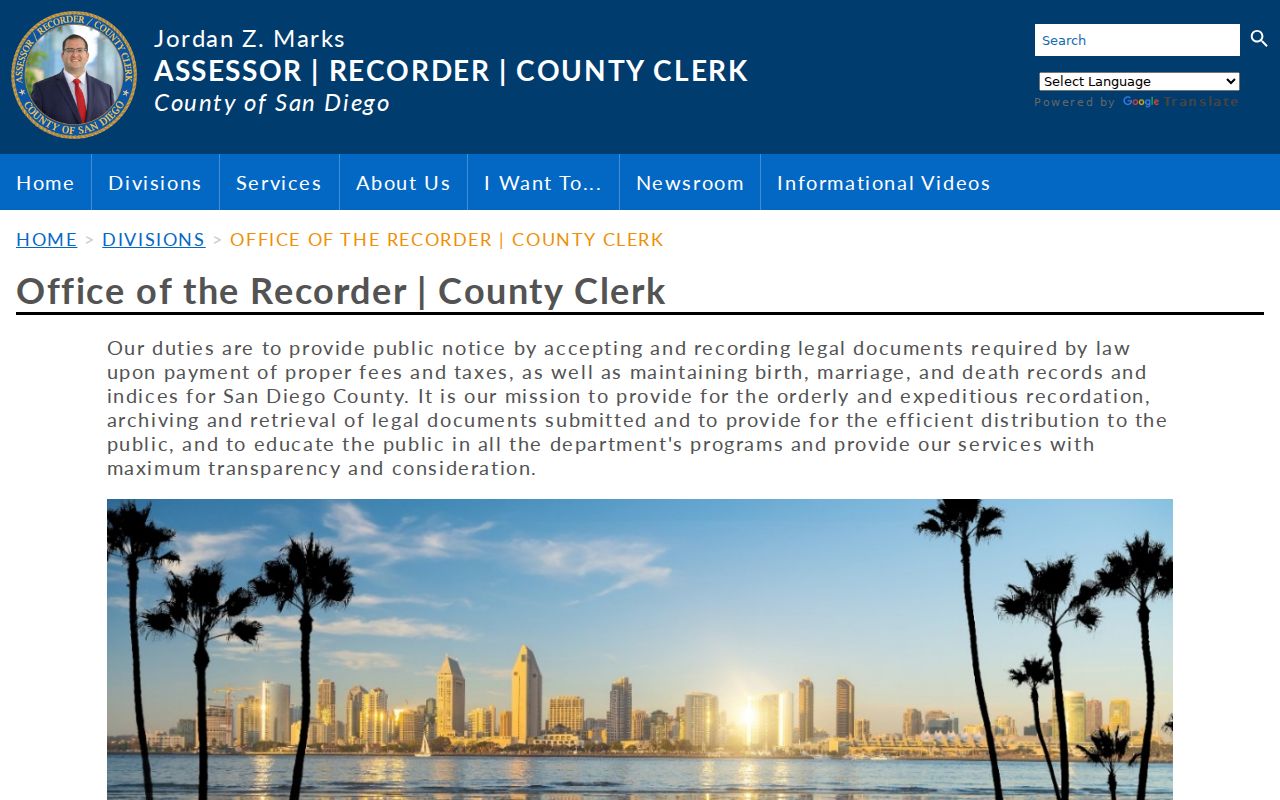
The ARCC Recorder-Clerk office information separates indexed data from the controlled route to document images.
A party hit is a lead, not proof of occupancy.
Trace Oceanside Previous Residents by Deed
Begin with a current owner only when the name came from a deed or permitted office channel. The safer continuity key is the legal description, not a modern street label. A clean chain links present vesting to earlier sellers while leaving occupancy open for directories and census work.
- Search Oceanside GIS by address or intersection. Record APN, parcel outline, subdivision, lot, block, and situs.
- Obtain the vesting deed through ARCC plus a copy or kiosk. Record grantor, grantee, legal description, record dates, document number, and book/page.
- Identify the seller named as grantor, then search that seller as an earlier grantee. Check the legal description against the next deed.
- Repeat the name, role, dates, document number, and description check back through 1970. At the cutoff, use kiosks, books, and archives.
- Lay deeds beside directories, census, permits, obituaries, and probate. Ownership, occupancy, building work, and family succession are separate evidence.
- Grantor and grantee
- The grantor transfers an interest; the grantee receives it. Neither role proves occupancy.
- Chain of title
- The linked sequence of recorded transfers connecting a present interest to earlier parties and descriptions.
- Legal description
- Formal lot, block, tract, or boundary wording that identifies land when street names shift.
- Situs and mailing address
- Situs is the parcel location; mailing is where notices go. They can differ and neither proves physical presence.
- Criss-cross directory
- An address-ordered directory, usually by street and number, showing listed households beside nearby entries.
- Enumeration district
- The census area assigned to an enumerator, useful when an older address needs a map crosswalk.
The official recording rules explain the index, copies, and recording process. The posted ARCC fee schedule helps distinguish a copy charge from an unsolicited deed-copy letter.
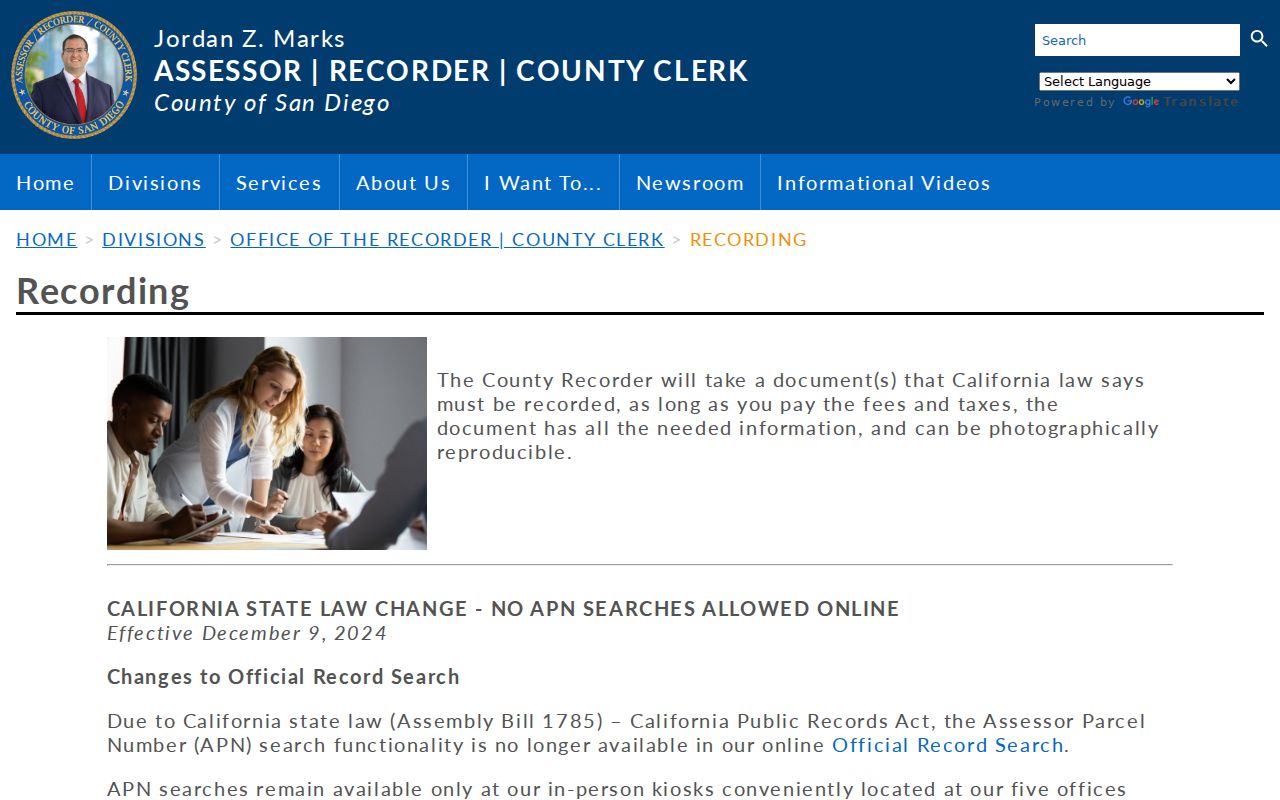
An indexed transfer is a lead to verify, not a complete answer about past residents.
Oceanside Residents: House-History Archives
The Helen M. Nelson Heritage Room at the Civic Center Library holds more than 2,500 local-history books, files, clippings, and photographs. Obtain staff permission at the second-floor Customer Service Desk. Ask for a surname, street, subdivision, institution, or business file, not only a city-directory title.
The Oceanside Historical Society's Robert A. and Bessie J. Weese Oceanside History Center, at 510 Civic Center Drive, adds finding aids, photographs, organizational records, Water Utilities history, and research help. Contact (760) 722-4786 or Info@OceansideHistoricalSociety.org. The Weese Collection finding aid routes a house-history question. Blade-Tribune clippings and photographs add dated context, but captions need deed or directory support.
Exact Oceanside directory publisher runs, reverse-directory runs, and digitized samples were not published in inspected catalogs. Ask staff for the title, volume date, abbreviation key, shelf location, and access limit.
Oceanside Street Names Across Time
A street-name gap can make previous residents disappear from a simple address search. Historical Oceanside references use names that differ from today's labels. Search both forms, then confirm the parcel through a legal description, subdivision map, photograph, or landmark.
- First Street became Seagaze.
- Second Street became Mission Avenue.
- Third Street became Pier View Way.
- Fourth Street became Civic Center Drive.
- Hill Street became the Coast Highway spine.
- Couts Street, where the first pier ended, became Wisconsin.
The second pier ended at Third, now Pier View Way. These crosswalks connect photographs, directory entries, hospital references, and deeds to a present block. A missing hit may reflect a former county or ranch description, annexation, a split parcel, a name variant, or directory timing. None proves that a home had no resident.
Use the Oceanside historical timeline beside GIS and the recorder record. Log both labels and compare lot or block language before joining records.
Note: A street-name crosswalk is a research aid, not permission to merge records without matching parcel or household evidence.
Oceanside Past Residents: Census and Directories
Deeds tell who transferred land. Previous residents who occupied an address are more often found by pairing a dated directory entry with a census household. Exact local runs are not published, so do not invent a year or publisher. Read the volume's abbreviation key. An entry may include name, spouse, occupation, address, and a residence mark; a criss-cross section orders the city by street and number.
Use the federal census through 1950 for household composition on the enumeration date. Entries are snapshots, not continuous occupancy records. The National Archives census route can help locate the right enumeration district after an old street name is translated.
- Choose a repository-supplied directory year and record the name, address, spouse notation, and household mark.
- Check reverse or criss-cross pages for the number and nearby entries, preserving the volume's street spelling.
- Match the address to the nearest census year and inspect household, age, relationship, and occupation fields.
- Compare the next directory, then check deeds and permits for an event that explains arrival or departure.
- Use an obituary or probate file to test a death, heir, or family link, not just a repeated surname.
Lawful house history. Previous-resident research in Oceanside is appropriate for genealogy, family history, heir work, and personal curiosity. Do not use records to harass, track, impersonate, or expose a living person, and respect confidential-address programs and sealed records.
Oceanside Previous Residents in Permits
Permit records add a building timeline. Oceanside's eTRAKiT interface exposes permit, project, property, contractor, and inspection searches, but is labeled pre-production. Its exact digitized start year was not confirmed. Treat an applicant, owner at application time, architect, contractor, issue date, final date, valuation, or inspection as a project fact, not proof of continuous occupancy.
When the online route is incomplete, verify production access with Development Services or send a focused request through the Oceanside City Clerk public-records channel. Name the address, permit or project number, date span, department, and record type. A request seeks an existing record; it does not require the city to create a new resident list.
Sanborn fire-insurance maps can add footprint, material, use, and street context. Exact Oceanside sheets and years were not confirmed, so search the Library of Congress Sanborn collection and local library holdings without stating that a particular sheet exists. Compare a map footprint with GIS, a recorded subdivision map, and a photograph before assigning a past household to the building.
Oceanside Previous Residents and Local History
Oceanside's records story is continuity through institutional and street change. Andrew Jackson Myers's 1883 homestead claim, railroad settlement, and incorporation on July 3, 1888 mark the shift toward a platted town. The county land and court trail is older, so an early address may sit in a county or mission context first.
The library began in 1904 and moved through several sites before the 1989 Civic Center. Third Street, Hill Street, Second Street, 704 Pier View Way, and North Nevada can appear in captions. Camp Pendleton made household appearances time-sensitive: a family may show briefly in a directory, newspaper, photograph, or school record, then leave a different trail in deeds or probate.
Do not explain a gap with an unsupported courthouse-disaster story. The documented local issue is the mismatch between record systems: the recorder web index starts in 1970, the broad court web index starts in 1974, and older court material reaches back through central indexes to 1880. Preserve those limits in the research log.
Finish an Oceanside Residents' House History
When the deed chain and household trail stop, use records that explain the person's departure or the property's change. The Superior Court online index covers major categories broadly from 1974-present, including probate, while older central hardbound indexes cover 1880-1964 and computer-generated indexes continue to mid-1974. Online results can be followed by a mailed-copy, counter, or archive request when the file is not remotely available.
Probate petitions, recorded heir documents, and obituaries can connect a deceased owner or listed household to relatives. Search the name, former address, spouse, and street variant separately. A repeated name is only a lead until the legal description, age, family relation, dated address, or case role agrees with another record.
- Log the last confirmed deed, directory, census, permit, or photograph with its date and record role.
- Search the matching probate or court index, then request the available file or copy through the court's stated channel.
- Check Heritage Room files, Weese finding aids, Blade-Tribune material, and photographs for a dated departure or family clue.
- State the remaining gap plainly: an unconfirmed directory run, a missing older index, an unverified map sheet, or a street-name mismatch.
For a current parcel-by-parcel chain, the Oceanside Street Directory route keeps GIS, APN, deed parties, and address evidence together. The result should be a dated, source-by-source house history, not a claim that every person connected to a parcel was a resident.