
What Oceanside Records Can Confirm
A useful Oceanside resident lookup separates identity, property, court, family, affiliation, and money clues. San Diego County is the main records county, while Oceanside supplies GIS, city-request, permit, and local-history routes. Each result answers a narrow question, so the first pass should preserve the record role rather than label every name a resident.
| Record | What It Confirms | Where to Search | Access |
|---|---|---|---|
| Deed index/image | Party name, transfer role, legal description | ARCC Official Records Index | Free metadata; image by copy or kiosk |
| Assessment/GIS | APN, value, parcel shape and location | Secured Roll and Oceanside GIS | APN search; owner name suppressed online |
| Voter record | Registration status and election districts | California voter confidentiality rules | Self-lookup or approved Elections Code use |
| Court index/file | Party role, case type, date and filings | San Diego Superior Court Court Index | Index free; files vary by case and channel |
| Vital record/index | Birth, death, marriage or dissolution event | County Recorder, CDPH and historic indexes | Authorized or informational copy rules |
| Business/FBN | Entity, registrant, agent or trade-name tie | SOS bizfile and County Clerk | Public indexes; copies or filings may differ |
| Professional license | License type, status and discipline link | DCA License Search | Free public search |
| Unclaimed property | Reported name, city, ZIP or property clue | California ClaimIt | Free lead; not proof of current residence |
Start with the record that matches the known clue. An address belongs first in GIS, an event date in a vital index, a legal dispute in the court index, and a trade name in the FBN or entity search. A deed party may own land without living there. A license address is an affiliation clue. A voter result belongs to the voter or a qualifying requester, not to an open name list.
Control a Same-Name Oceanside Resident Lookup
Same-name errors make a second pass essential. Save the middle name or initial, suffix, alias, spouse or associate, approximate age, event date, entity spelling, and prior address. Search exact and variant forms: compound surnames with and without spaces or hyphens, apostrophes, birth and married surnames, expanded initials, and accented and older ASCII spellings.
Require two independent concordant facts. A court party may share a name with a parcel owner, while a trust or business agent may not be the person sought. A mailing address can belong to a remote owner or service company. Record the source, date, name form, role, location, and reason the match aligns. The Oceanside Directory Book route adds yearbooks and newspaper context for classmates without turning one school-year entry into a current address.
Verify One Oceanside Resident
One-person research works best as an evidence grid. Anchor the name to the strongest known fact, then test records created for different purposes. The sequence checks an address association without assuming that an owner, voter, court party, or licensee is an occupant.
- Begin with the known name and address or event. Use Oceanside GIS for the parcel and APN, then use the ARCC secured roll for value facts. The online roll does not show the owner name.
- Run Superior Court Party Name mode with the last name, then add first name, case type, location, and filing-date range. Repeat meaningful variants.
- Compare party role and date with a deed, business filing, license, obituary, or vital index. Log the mode and date range for any no-hit.
- Order a certified copy only when the custodian and eligibility rules allow it. Otherwise use an informational copy or index clue.
A match strengthens when name, place, time, and record role agree, not when weak listings repeat one claim.
- Docket
- The court's running case record, including entries for filings, hearings, orders, and other actions.
- Index versus image
- An index is searchable metadata. An image is the scanned instrument and may require a fee, mail order, or counter kiosk.
- Certified copy
- A custodian-sealed, legally certified copy, unlike an informational copy or index printout.
Read the Oceanside Court Index
Oceanside matters generally route to San Diego Superior Court, often through North County. The Court Index offers Party Name, Case Number, and DA Number modes. Party mode requires last name and accepts first name; case type, location, and filing range narrow a common name. Case Number uses YYYY######## with no dashes. DA Number takes the criminal prosecution reference.
The online index broadly reaches 1974 forward for civil, criminal, family, mental-health, and probate categories. It excludes juvenile, traffic, minor-offense, and pre-1974 cases. Central Division Older Records holds indexes from 1880 to mid-1974: hardbound books for 1880 to 1964 and computer-generated indexes after 1964. A web no-hit is not proof of no court history.
The court's online case-search guidance shows the official route for these modes and limitations.
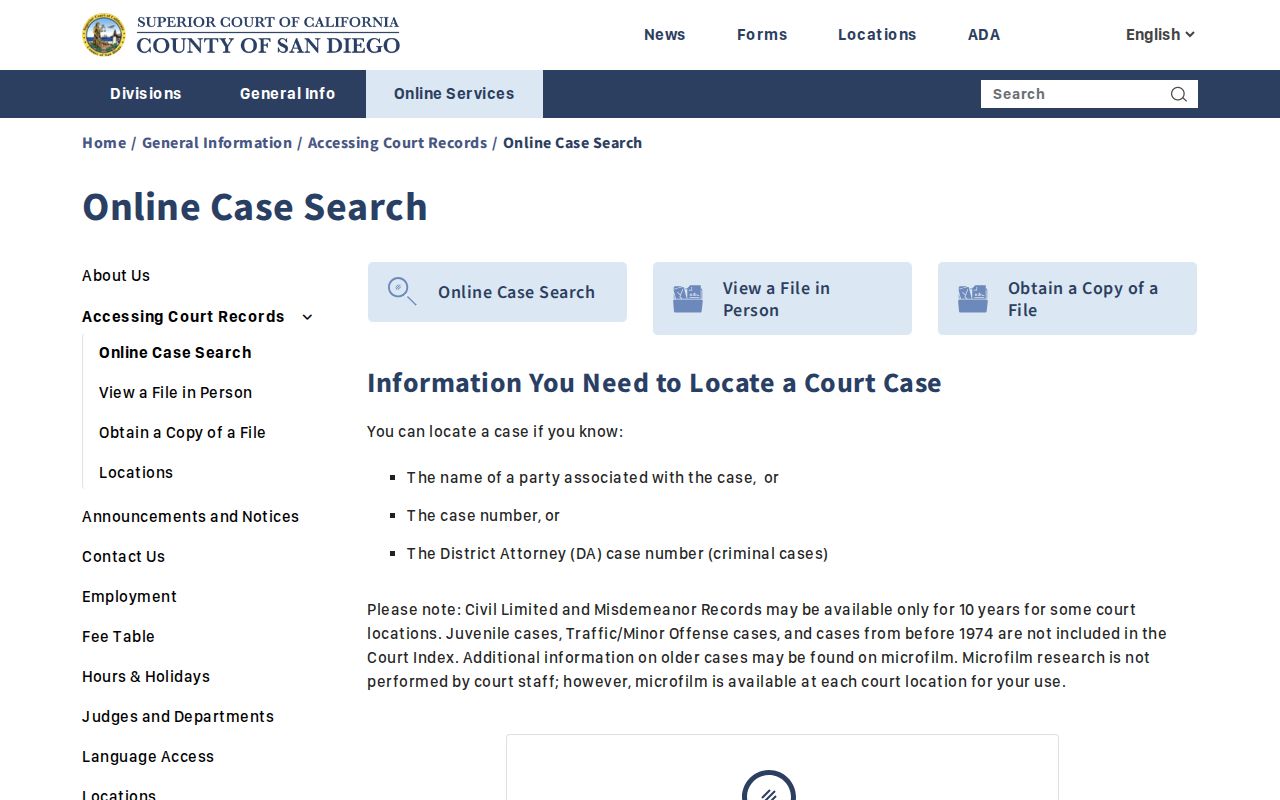
The search fields identify the test being run. Keep the filing range and case location with the result so another researcher can tell a narrow search from a broad one.
Court Files in an Oceanside Resident Lookup
A basic result can show case title, number, facility, type, filing date, and parties. It does not state the charge, disposition, or every document. Civil, Small Claims, and Probate documents filed on or after January 1, 2008 may have previews and paid Register of Actions downloads. Some imaged Family documents filed on or after August 24, 2015 can be ordered online and mailed. Criminal documents are viewed at the courthouse or ordered by mail, not downloaded.
The court access instructions cover online access, mailed copies, the counter, public terminals, archives, confidential records, and retrieval fees. Ask for file location, copy price, certification, and off-site retrieval time. Court staff does not perform microfilm research; juvenile, adoption, and sealed material has added limits.
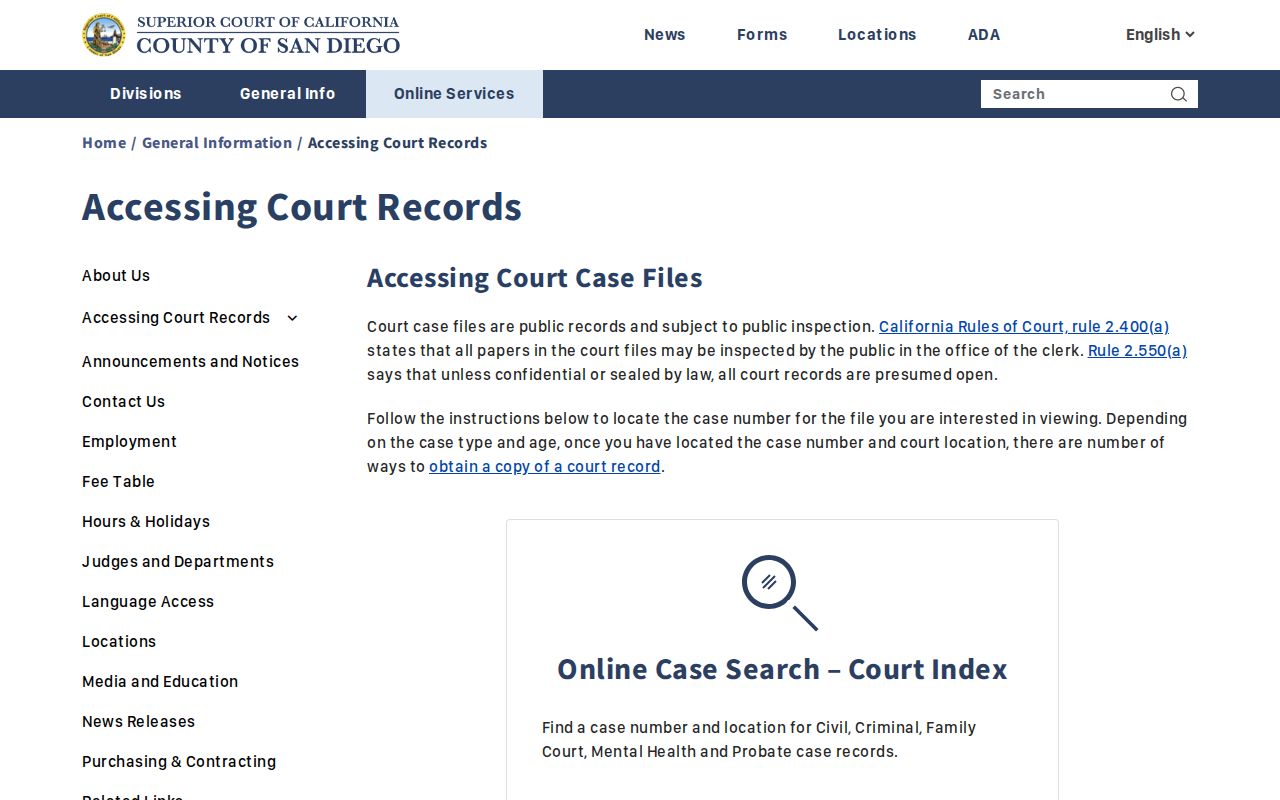
Sample index inventory: Party Name, party role, case title, case number, case type, facility, filing date, and result status. Sample file inventory: docket entries, pleadings, orders, judgments, exhibits, and certified-copy notation when available. Read the official file before describing an outcome.
Boundaries Around an Oceanside Resident Lookup
California voter data is not an open resident list. The San Diego County self-lookup asks for first name, last name, date of birth, residence address, and ZIP Code, then returns voter-specific status or election data. Questions go to the Registrar at (858) 565-5800 or rovmail@sdcounty.ca.gov. A full-file request needs the applicant, scope, qualifying purpose, security plan, delivery details, certification under penalty, and original signature. Mail or deliver it to 5600 Overland Avenue, San Diego; email and fax are not accepted.
Government Code §7924.000 protects home address, phone, email, precinct and prior-registration data, identifying numbers, signature, and related fields except as Elections Code §2194 permits for specified governmental, electoral, scholarly, journalistic, and political uses. Safe at Home supplies a substitute mailing address and confidential voter option under Government Code §§6205–6216. A missing name may reflect these rules.
Lawful use. An Oceanside resident lookup is for personal, lawful research. California Penal Code §646.9 addresses stalking, Penal Code §653m addresses repeated harassing communications, and Civil Code §1708.7 supplies a civil stalking remedy. Never use a record to threaten, impersonate, intimidate, or evade a confidentiality protection.
California Vital Records for Oceanside Names
A common myth says California certificates simply open after a fixed number of years. Health and Safety Code §103526 instead separates authorized certified copies from informational copies. Authorized people can receive identity-valid copies when they meet the rule. Other requesters may receive certified informational copies of many nonconfidential birth, death, and public-marriage records. Confidential marriages remain restricted, and adoption files are confidential under Family Code §9200.
San Diego County accepts birth requests in person, through VitalChek, and by mail. In person requires the application, clerk signature, and government photo ID. Mail goes to the San Diego Recorder/County Clerk, ATTN Vital Records, P.O. Box 121750, San Diego, CA 92112-1750; authorized requests need a notarized sworn statement, informational requests do not. The County Recorder handles county birth, death, and locally licensed marriage records. The current marriage application lists relationship, identity, notarization, mailing, and payment fields. CDPH maintains statewide events since July 1905. Divorce decrees come from Superior Court.
For 2026, county fees are $34 birth, $26 death, and $19 marriage. CDPH lists $31, $26, $19, and $18 for birth, death, marriage, and dissolution. Verify fees, vendor charges, eligibility, and forms with the County Recorder and CDPH Vital Records form catalog before payment; online ordering can add vendor charges.
CDPH's 2025 implementation of AB 64 permits specified diacritical marks on vital records. Search both the accented form and the older unaccented index form when the event predates that change.
The San Diego County birth-certificate guidance sets out eligibility and ordering channels for a county vital-record request.
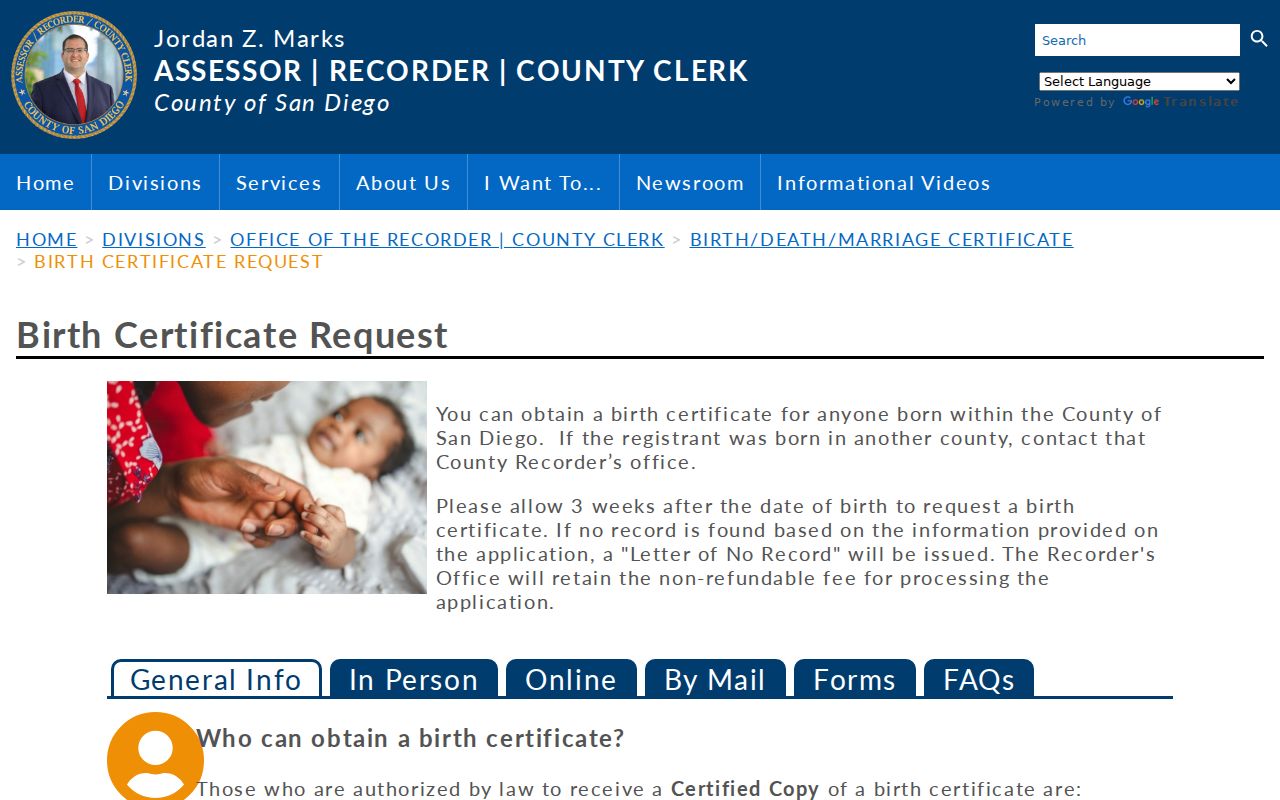
The form route separates an authorized certified copy from an informational copy, so the requester’s relationship and identification matter.
Human Trails in an Oceanside Resident Lookup
Family research needs a lawful purpose and the right custodian. An heir trail can move from a probate petition or notice to a recorded deed, obituary, and publicly named family filing. Probate proves a court process and party role, not a current address. Pair the name with a date, legal description, spouse, or executor.
Birth-parent or adoption questions require authorized California CDSS, CDPH, and court channels. Family Code §9200 keeps adoption files confidential. Mission and parish registers, newspapers, yearbooks, and the Heritage Room can add adult genealogy or classmate context, but a school-year entry is not continuous residence.
Oceanside Business and License Clues
Affiliation records can separate two people with the same name. Secretary of State bizfile Online returns entity number, status, formation, jurisdiction, agent, addresses, and filing history. San Diego County FBN records add a trade name, registrant, and filing facts. An FBN does not create a corporation, and an agent or mailing address is not proof of residence.
The DCA License Search accepts name, license number, city, type, and board filters. Results can show type, number, status, issue or expiry, address disclosure, and discipline links. Each board has a distinct scope, so compare an affiliation clue with a date and independent record. ClaimIt accepts name, city, ZIP, or property ID; a free result is reported-property history, not current residence, and a claim needs Controller-reviewed proof.
Correct an Oceanside Records Match
Corrections start with the custodian that created the fact: ARCC for an index or redaction procedure, the assessor for parcel facts, the court clerk for a docket, CDPH or the county registrar for a vital amendment, and the Registrar for voter data. Correct downstream copies after the source is clear.
For an existing, nonexempt city or county record, use a focused California Public Records Act request under Government Code §§7920.000–7931.000. Give a date range, department, address, permit or case number, and record type. The Oceanside City Clerk route cannot create a new list or disclose exempt material. Counter terminals, mailed copies, archives, library staff, and recorder kiosks remain useful fallbacks.
Current Oceanside Lookup Warnings
Record systems change. ARCC removed APN searching from its online Official Records Index on December 9, 2024, while retaining it at five kiosks. The 2026 secured-roll page reflects June 30, 2026 and still withholds owner names online. Confirm current instructions.
Scams imitate real channels. A deed-copy letter may overcharge; a property-fraud alert signals a document to inspect, not proof by itself. ARCC's OWNER ALERT is the official monitoring route. Check recovery pitches against free ClaimIt, verify urgent court or family requests through a published government number, and save the search date.